Walk down the filter aisle at any hardware store, and you will find a wall of options, each with a different number, a different brand scale, and a different claim on the box. MPR 1500. FPR 10. MERV 13. They sound like they might mean the same thing. They do not.
Here is what the numbers actually mean, what the EPA recommends, and what to do if your system cannot accommodate it.
What MERV Measures
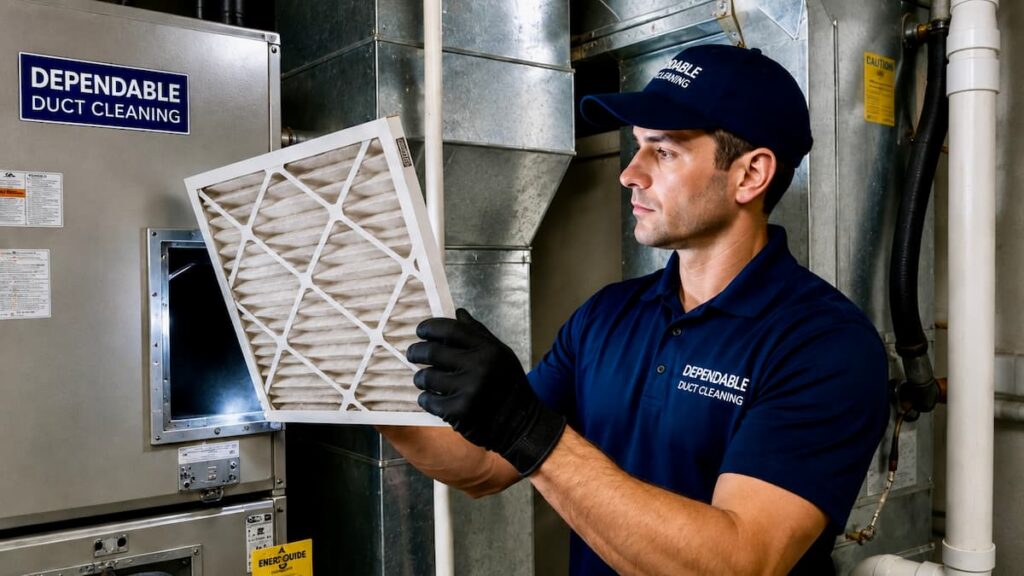
MERV stands for Minimum Efficiency Reporting Value. It measures a filter’s efficiency at capturing particles across a range of sizes, tested to the ASHRAE 52.2 standard. The higher the number, the more efficiently the filter removes particles across most size categories.
The EPA notes that MERV is based on a national consensus standard. FPR, or Filter Performance Rating, is a scale proprietary to Home Depot. MPR, or Microparticle Performance Rating, is proprietary to 3M. They are marketing scales, not independent standards, and they do not map cleanly onto each other.
A rough reference for the hardware store aisle:
MPR 300 to 600 is roughly MERV 8 to 10. MPR 1000 to 1200 is roughly MERV 11. MPR 1500 to 1900 is roughly MERV 12 to 13. FPR 4 to 5 is roughly MERV 8. FPR 7 to 8 is roughly MERV 11. FPR 9 to 10 is roughly MERV 13.
When in doubt, look for the MERV number. It is the only one that means the same thing regardless of where you buy it.
What the Common Ratings Actually Do
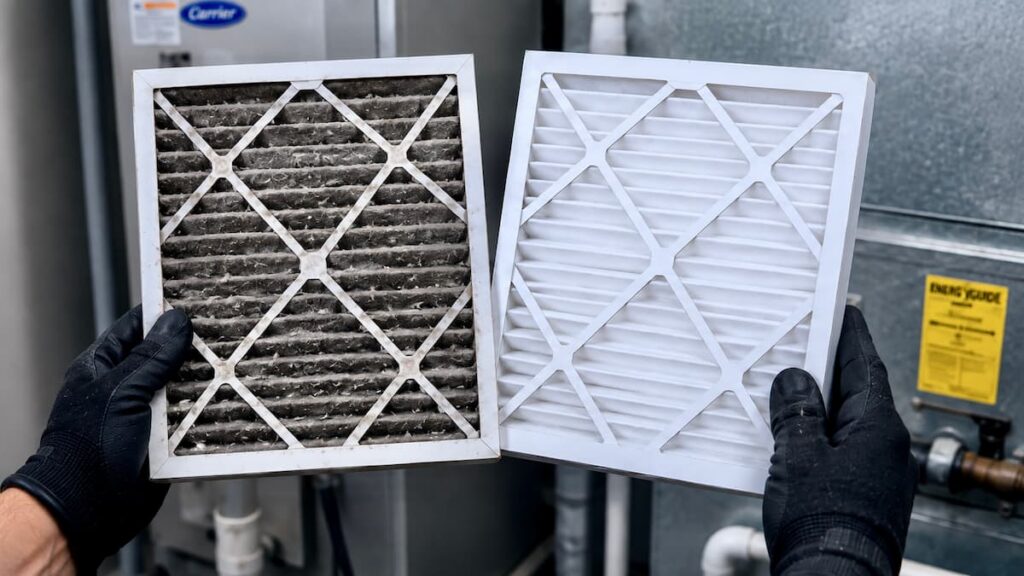
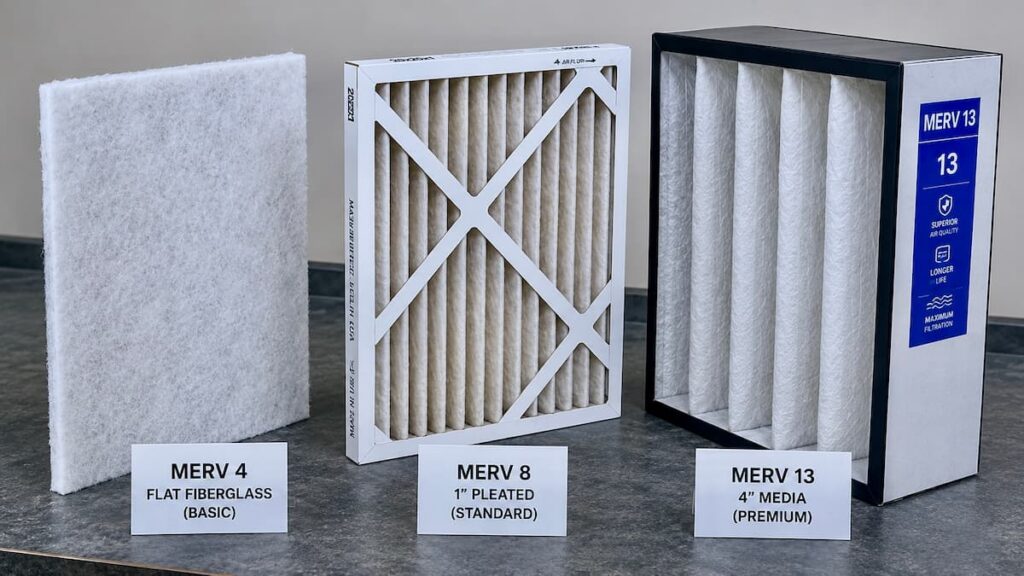
MERV 1 to 4 are the flat or panel filters common in older residential systems. They exist primarily to protect the equipment, specifically fan motors and coils, from dust buildup. They do very little for air quality and are inefficient at capturing smaller particles.
MERV 5 to 13 are the pleated filters most homeowners should consider. The EPA notes that filters in the MERV 7 to 13 range are likely nearly as effective as true HEPA for most airborne indoor particles.
MERV 14 to 16 sometimes get marketed as HEPA equivalent. They are not. True HEPA falls in the MERV 17 to 20 range and is not typically installed in residential systems. Standard air handlers and residential ductwork cannot accommodate them because of size and airflow resistance. A filter rated that highly would starve most home systems of air.
Mike, our Owner and Operator, says: “We see homeowners buy the most expensive filter on the shelf thinking it’s always better. But if your system can’t move air through it properly, you’re not protecting your air quality. You’re straining your equipment.”
Filters Only Work When the System Runs
This is the point most filter articles skip, and it matters. Your furnace or air handler filter only cleans air when the system is actively running. During heating and cooling seasons, that is typically less than 25 percent of the time.
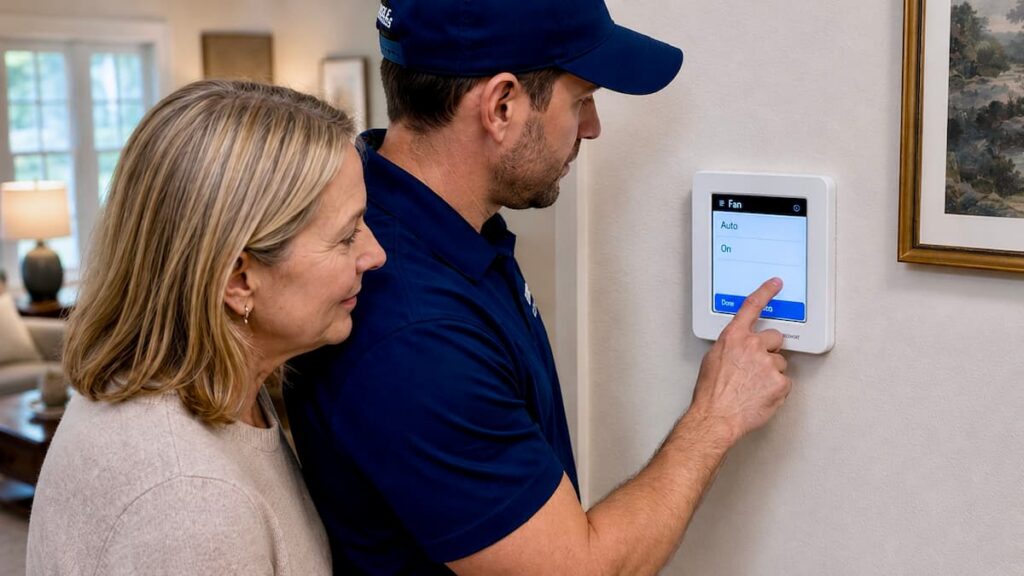
If you want more filtration, you can run the system fan continuously using the fan-on or circulate setting on your thermostat. The tradeoff is real: longer fan run times increase electricity costs and, in cooling season, can mean less reliable humidity control as the coil does not stay cold enough to condense moisture efficiently.
It is worth knowing before you set it and forget it.
Fit and Bypass
A filter with a perfect MERV rating and a gap around the frame filters nothing through that gap. The EPA is explicit that air bypassing around a loose or improperly seated filter is a real problem, and one of the simplest to fix.
Check that your filter fits snugly in the housing with no daylight around the edges. If the frame is bent, the slot is oversized, or the filter has shifted, air is finding a path around it.
Mike recommends “checking the fit every time you change the filter. It takes ten seconds, and it’s one of those things that makes a real difference.”
EPA's Recommendation, and the Part People Skip
The EPA recommends selecting at least MERV 13, or as high as your system will accommodate. That first part gets repeated often. The second part matters just as much.
Any higher-efficiency filter, MERV 13 through 16, must be compatible with the existing duct system so added resistance doesn’t impede airflow. In some homes, a trained professional may need to modify the system to fit one properly.
Practical steps: check your equipment manual for the manufacturer’s filter recommendation. If you want to go higher, have a technician measure static pressure. If your system takes a one-inch slot and cannot handle MERV 13, a media cabinet installed at the air handler is often a better solution than forcing a filter the system wasn’t designed for.
Signs your filter may be restricting airflow: rooms that take longer than usual to reach the set temperature, weak airflow at registers, longer run times, or, in summer, ice forming on the coil.
Mike suggests “getting this checked rather than guessing. A filter that’s too restrictive for your system can cause more problems than a lower-rated one that fits properly.”
How Often to Change It
Change on loading, not on the calendar. The EPA advises following manufacturer recommendations and changing filters more often when they become clogged. Higher-MERV filters load faster than lower-rated ones because they are capturing more. Pet households load filters faster. During post-renovation periods, when drywall dust and construction debris are in the air, they load even faster.
A practical approach: check the filter monthly and change it when it looks gray and dense, not because three months have passed.
What a Better Filter Will Not Do
A higher-MERV filter will not remove odors or volatile organic compounds. MERV measures particle capture, not gases. It will not fix a moisture problem. It will not substitute for addressing a contamination source at its origin. And it will not clean ductwork that already has years of buildup inside it
For that last point, see our article on how to tell whether your air ducts actually need cleaning, and our residential air duct cleaning services serving Fairfield, Litchfield, and New Haven Counties.

We Check This When We Visit
When Dependable Duct Cleaning comes out for any service, we are happy to look at your current filter, discuss what your system can accommodate, and check for signs of airflow trouble. We won’t pressure you to upgrade anything. Our job is to give you accurate information so you can make a good decision for your home.
Schedule a free in-home estimate or call us at (203) 364-1950. We serve homes and businesses throughout Fairfield County, Litchfield County, and New Haven County, CT.