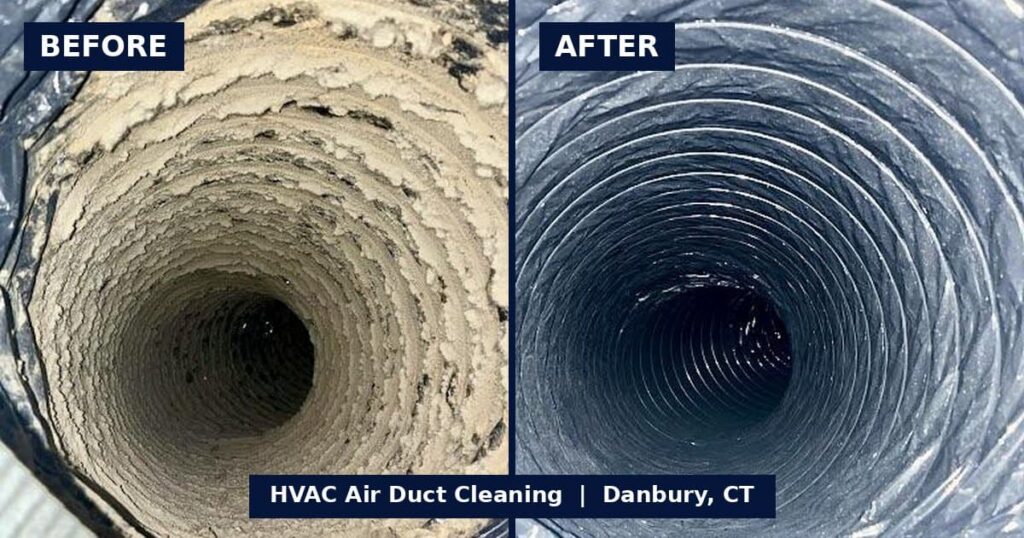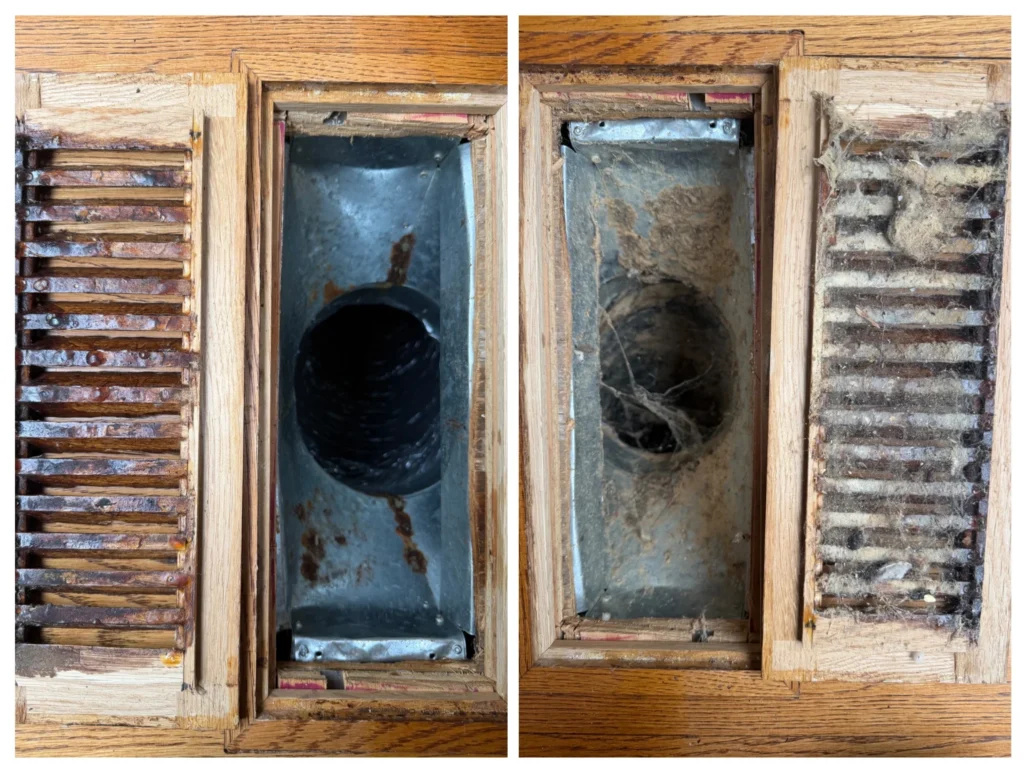
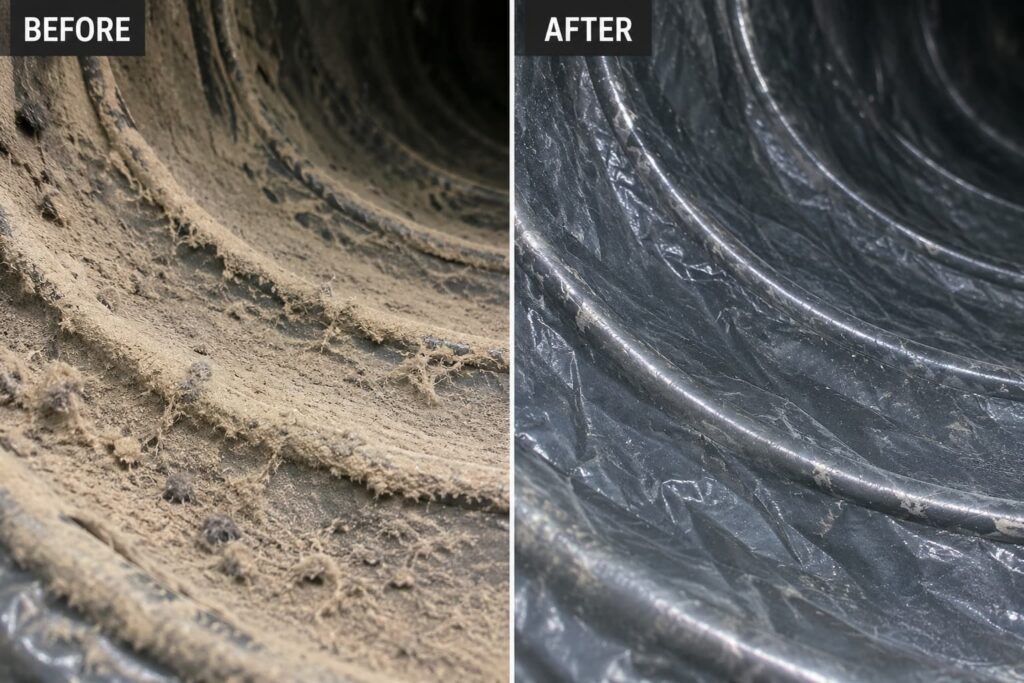
Look closely at the bend in the duct in our before photo. A pale layer of dust follows the curve, collecting along the raised edges of the flexible liner and settling into the folds between them. In the after photo, you can follow those same folds into the bend. This time, you can see the dark liner underneath.
These photos from our air duct cleaning project in Seymour, CT show a part of the house that’s easy to overlook. You might remember when you replaced the furnace or finally installed central air. When did the ducts themselves go in? In Seymour, that can be a different chapter in the house’s history.
Why the Age of a Seymour Home Tells Only Part of the Story
Seymour sits in New Haven County, in Connecticut’s lower Naugatuck Valley. Route 8 follows the Naugatuck River through town. Head west from the river and the land rises toward Great Hill. On the east side is Skokorat. Across town, you’ll find modest early- to mid-century houses, single-story ranches, and contemporary homes. Seymour’s 2022 housing plan puts the median year built at 1965. Nearly one in four homes in its survey dated to before 1940, while just over half were built between 1940 and 1979.
That mix matters when you’re trying to understand what’s behind a vent. Take a mid-century ranch with a basement furnace. If the house has forced-air heat, the same floor registers may deliver warm air in January and cool air in July. An older two-story home can work quite differently. If it still has radiators or hot-water baseboards, those deliver heat through pipes. The ceiling vents upstairs may belong to a separate air-conditioning system added years later. Two Seymour homeowners can both say they have “central air” and be describing very different setups.
When Did Central Air Become Common?
Here’s one way to put that 1965 construction date in perspective. As late as 1973, only 17% of U.S. homes had central air conditioning. By 2009, 65% did, according to the U.S. Department of Housing and Urban Development. Those figures are national, but they help explain a familiar feature of older Connecticut houses. A home could spend its first few decades with a boiler and window units before an owner added central cooling. A house with a forced-air furnace, meanwhile, might already have had ducts when the AC arrived.
Mike suggests, “If you’ve bought an older home in Seymour, ask one question: when the heating or cooling equipment was replaced, which ducts did they keep? The installation invoice may tell you whether they put in new ductwork, reused the old runs, or added a branch for a finished room. That history is a big help when dust is coming out of the vent in an addition while the original bedrooms look fine.”
When HVAC Air Ducts Do Need Cleaning

The National Institutes of Health’s duct-cleaning fact sheet identifies specific conditions that warrant attention, and the EPA also recommends residential duct cleaning as needed. Owning a 1960s ranch, or reaching the anniversary of your last cleaning, isn’t enough reason to book the work. Here’s what to look for:
- Dust or debris blows into a room. Watch what happens when the fan starts. Dust resting on a grille face is common. Particles coming through a supply vent, or debris inside a duct that restricts airflow, warrant a closer look.
- You see suspected mold growth or persistent water damage. Have the affected section inspected and identify the moisture source. A leak or condensation problem needs correction, and wet or moldy duct insulation may require replacement.
- Rodents or insects have nested in the ductwork. Address the infestation and how the pests got in. Then have the affected runs evaluated for cleaning.
- An unexplained odor returns when the system runs. Note which rooms you smell it in and whether it happens during heating, cooling, or both. Those details can help a technician trace the odor to a duct or another HVAC component.
- A remodeling project generated heavy dust. If you've just refinished floors or sanded drywall and the registers were open, check for debris that made its way inside. An inspection can establish whether enough has accumulated to justify cleaning. For the next project, plan to protect the duct openings before dusty work begins.
Mike believes, “A birthday on the calendar isn’t a reason to clean your ducts. What’s actually happening inside the system is. If I look and it’s fine, I’ll tell you so, and you’ll save your money for another day.”
How We Can Help
When cleaning is the right call, our residential duct cleaning team uses HEPA-filtered equipment and follows NADCA standards, so we capture the debris we loosen instead of recirculating it. You can see everything that’s included in our air duct cleaning service. And while we’re there, ask us about dryer vent cleaning. A clogged dryer vent is a leading cause of house fires.
Mike recommends, “If we’re already in your basement looking at the ducts, let us check the dryer vent too. It only takes a few minutes, and it’s one of the simplest ways to make a home safer.”
Have a Question About the Ducts in Your Seymour Home?
The before photo from this job shows exactly where the dust settled. If you’re wondering about your own system, start with what you’ve noticed. Which vent? Which room? What happens when the system turns on? At Dependable Duct Cleaning, we start with a free, in-person estimate so we can review your ductwork and explain what we find.
Call (203) 364-1950 or request a free air duct cleaning estimate in Seymour, CT.
Related reading: How to Tell If Your Air Ducts Need Cleaning and Before-and-After Floor Register and Vent Cleaning in Redding, CT.